
Limits of Functions – Lecture 7
Topic: Determining Limits of Functions from the Definition
Summary
In this article, I will show through several examples how to prove from the definition (Cauchy’s or Heine’s) that a number is — or is not — the limit of a function. Before reading this article, you should understand both definitions of limits: Heine’s definition based on limits of sequences, and Cauchy’s definition based on neighborhoods of a point.
Cauchy Limits – Example 1
Prove from the definition that the number is the limit of the function as x approaches 1.
In other words, we must prove that:
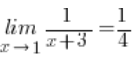
We will use Cauchy’s definition of the limit. Recall it:
A number g is called the limit of a function at the point , if:

In our specific example we have:
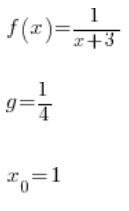
So we must show that no matter how small  we choose, we can always find such a
  , that from the inequality
 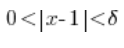 it follows that
 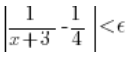 .
.
Take any and consider the inequality:
Notice something important: the choice of in the inequality depends entirely on us. We may choose it however we like — the only requirement is that the implication holds.
(Here follows the graphical illustration and step-by-step determination of x₁ and x₂, solving the equations, and choosing δ as the smaller distance from 1 to either x₁ or x₂.)
Thus, for every , we can choose such a 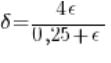 , that the condition
 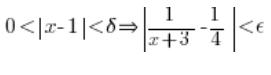 is satisfied.
Therefore, the function 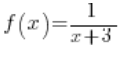 has limit
  at the point 1.
Cauchy Limits – General Method
Generalizing the above approach (so that we do not need to draw the graph), to prove from Cauchy’s definition that  has limit g at
  , we can:
1. Solve the equations:
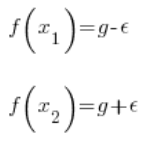
2. Define δ as:
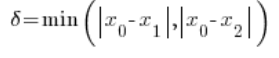
—that is, the smaller of the distances between and the endpoints x₁ and x₂.
Cauchy Limits – Example 2
Prove using Cauchy’s definition that the number is not the limit of the function as x approaches 1.
To prove that a number is not a limit, we must show that there exists a neighborhood of that value for which we cannot find any suitable δ. In logical terms: negation reverses the quantifiers.
(Here follows the graphical argument and construction showing that such δ does not exist.)
Thus, the function does not have limit 0.3 at the point 1.
Heine Limits – Example 3
Using Heine’s definition, prove that the limit of the function at 2 is 9.
According to Heine’s definition, we must show that for every sequence tending to 2, the corresponding sequence of function values tends to 9.
It is not enough to check one particular sequence. The property must hold for every sequence.
(Taking a general sequence approaching 2 and using properties of convergent sequences, we conclude that the function values always converge to 9.)
This proves the function has limit 9 at 2.
Heine Limits – Example 4
Using Heine’s definition, prove that 2 is not the limit of the function at 1.
To disprove a limit using Heine’s definition, we must find one sequence approaching 1 whose corresponding function values do not approach 2.
(Choosing a standard sequence approaching 1, we show that the function values converge to a number different from 2.)
Therefore, 2 is not the limit at 1.
Comparison of Definitions
Am I the only one who feels that Heine’s definition is faster, clearer, and more convenient in practice? 🙂
END
Click to review Cauchy’s definition (previous Lecture) <–