


Limits of Functions Lecture 5
Topic: Limits of Functions at a Point – Heine’s Definition
Summary
In this article, I introduce the definition of the limit of a function using the limit of a sequence. This is the so-called Heine definition of the limit of a function (there is also another one — Cauchy’s — and of course the two are equivalent). Before reading this article, it is helpful to understand what a function is (assigning numbers to other numbers), what arguments and values are, how to draw a function on a graph (simple test: if a function takes value 4 at argument 3 — how do you mark this on the graph?), and to have a basic understanding of limits of sequences and what it means for a sequence to converge.
Limit of a Function – What Is It About?
Consider the following (somewhat unusual, but illustrative) function:
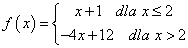
Recall from high school that this notation does not describe two functions, but ONE function that assigns values according to the formula  for arguments less than or equal to 2, and according to the formula
  for arguments greater than 2.
For example, this function assigns to the argument  the value
  (since 1 is less than 2, we use the first formula).
For the argument  , the function assigns the value
 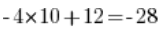 (since 3 is greater than 2, we use the second formula).
A table of arguments and values could look like this:

For arguments x less than or equal to 2, I calculated values using  , and for arguments greater than 2, I used
 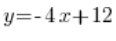 .
.
Plotting these on a graph gives:
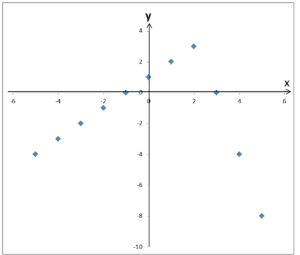
If we now try to “connect the dots”, we encounter a problem. To the left of 2 we use the same formula , so we can sketch the graph there:
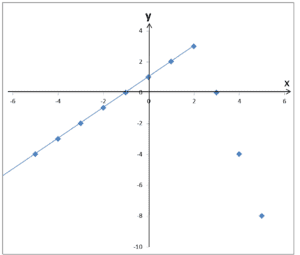
If we mechanically connect all points, we obtain an incorrect graph:
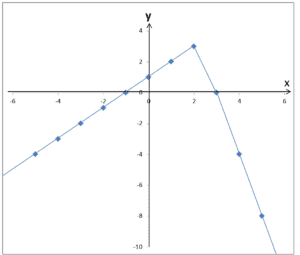
However, checking carefully the points to the right of 2, we see that the correct graph looks like this:
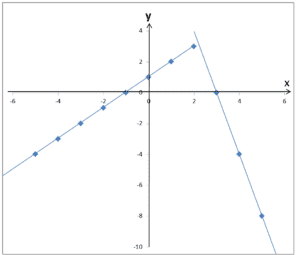
Let’s verify numerically. For arguments greater than 2 we use .
For example, for the argument  , the value equals
 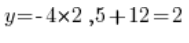 .
.
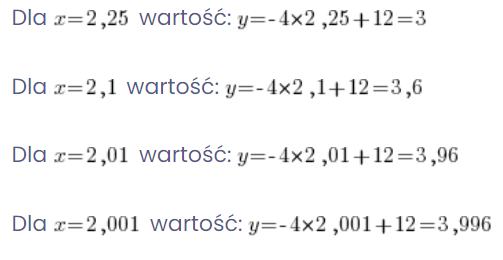
Clearly, for the chosen sequence of arguments 2.5; 2.25; 2.1; 2.01; 2.001 approaching 2, the corresponding sequence of values 2; 3; 3.6; 3.96; 3.996 approaches 4 (but never actually reaches 4).
Marking these points on the graph:
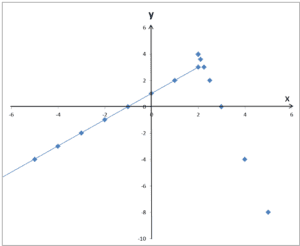
…and connecting them:
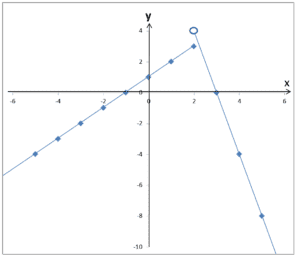
The open circle emphasizes that although the graph approaches 4, it never actually reaches it.
Situations like this — where arguments approach some number  and the corresponding function values approach some number
  — mean that the function has limit equal to at the point .
Not that hard, right? Unfortunately, we now need to make it slightly more precise.
Left-Hand and Right-Hand Limits
In our example, we must distinguish between approaching 2 from the right (values approach 4) and approaching 2 from the left (values approach 3).
Thus, the function has right-hand limit equal to 4 at 2 and left-hand limit equal to 3 at 2.
If these two limits were equal, we could simply say: “the function has limit equal to … at 2”.
Definition of the Limit of a Function
Let us now give the formal definition (first for the right-hand limit). This is Heine’s definition, based on limits of sequences:
We say that g is the right-hand limit of the function at if
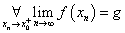
That is: for every sequence of arguments approaching from the right, the corresponding sequence of function values approaches .
Notice the crucial words: “for every”. The sequence approaching the point must be arbitrary.
In our example, choosing one specific sequence was not a formal proof. A proof requires showing that for EVERY sequence approaching the point from the right, the values converge to 4.
The left-hand definition is completely analogous.
We say that g is the left-hand limit of the function at if
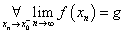
Finally, we define the (two-sided) limit:
We say that g is the limit of the function at if
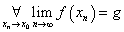
That is: for every sequence approaching , the corresponding sequence of function values converges to the same number .
The limit exists if and only if the left-hand and right-hand limits are equal. In our example, the function does NOT have a limit at 2 (although both one-sided limits exist).
END
Click here to review improper limits of sequences (previous lecture) <–