


Sequence Limit Lecture 4
Topic: Improper Limit of a Sequence
Summary
In this article, I will define improper limits of sequences:  and
and  .
.
Improper Limits of Sequences
When discussing limits of sequences, we must distinguish three situations:
1. Convergent sequences – those that have limits.
For example, the sequence:
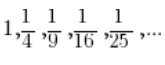 – that is, the sequence with general term
  .
.
This sequence has limit equal to 0. We say that it “converges to zero”.
2. Divergent sequences that do not have limits.
For example, the sequence:
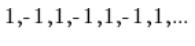
This sequence does not approach any number. It has no limit at all.
Among divergent sequences that do not approach any number, we can distinguish those whose terms become larger and larger (or respectively smaller and smaller) and diverge to infinity (or to minus infinity).
For example:
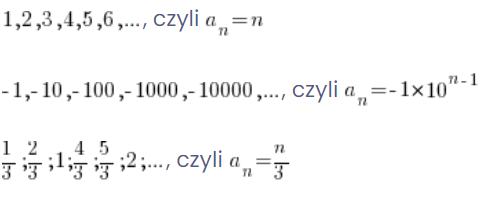
Such sequences are called:
3. Sequences diverging to (or to ). We also say that these sequences have an improper limit or .
How do we formally define such an improper limit? It will be a kind of definition of infinity understood as an improper limit of a sequence.
Let us consider: when can we say that the sequence
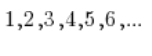
…diverges to ?
We say: A sequence has improper limit if for every fixed number (even very, very large — say 100 trillion, etc.) there exists an index of the sequence such that all terms with greater indices are already larger than that number. Formally, this can be written as:

Less formally: a sequence has improper limit if no matter how large a number we choose, from some index onward all terms of the sequence are greater than that number.
The case of limits diverging to is completely analogous.
A sequence has improper limit if for every fixed negative number  there exists an index
  such that all terms with indices greater than are already smaller than that number .

In other words: no matter how small a number we choose, from some index onward all terms of the sequence are smaller than that number.
Click here to review indeterminate expressions (previous lecture) <–