



Definite Integrals – Lecture 3
Topic: Darboux Sums – Helpful Integral Sums
Summary
In the first lecture I defined the definite integral: Definition of the definite integral In the next one I showed what difficulties come with using this definition for calculations, and how you can neatly get around them by using a certain theorem: The theorem on integrability of a continuous function Lecture 2 and computing using the integrability theorem was, however, a BIG leap forward. As you remember, I didn’t even try to prove the theorem I was using there—and that’s always a bit ugly in the mathematical world. So I’ll take one step back and remind you what exactly I had against the definition of the definite integral from Lecture 1. The point was that it was extremely inconvenient to use.Reminder of the “pure definition”
Let me recall the definition. Given a function f(x), a segment \left\langle a,b \right\rangle on the OX axis, infinitely many infinitely small intervals \Delta {{x}{k}} partitioning the segment \left\langle a,b \right\rangle , points {{\xi }{k}} inside those intervals and the values of the function f\left( {{\xi }_{k}} \right), the limit of the sum: \underset{n\to \infty }{\mathop{\lim }},\sum\limits_{k=1}^{n}{f\left( {{\xi }{k}} \right)}\Delta {{x}{k}} can be called a “definite integral” if:- this limit of the sum is always the same, regardless of which intervals \Delta {{x}_{k}} I choose
- this limit of the sum is always the same, regardless of where inside those intervals I choose the points {{\xi }_{k}}
- I chose the intervals \Delta {{x}_{k}} partitioning the segment \left\langle 0,1 \right\rangle so that each of them has the same length
- I chose the points {{\xi }_{k}} so that they are always exactly in the middle of each interval \Delta {{x}_{k}}
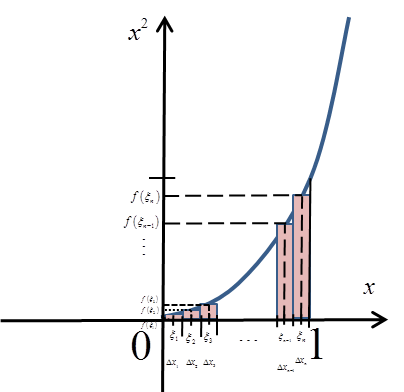 With these choices the integral sum:
\underset{n\to \infty }{\mathop{\lim }},\sum\limits_{k=1}^{n}{f\left( {{\xi }{k}} \right)}\Delta {{x}{k}} turned out to be equal to \frac{1}{3}.
But this does not mean (based on the definition alone) that the definite integral of the function f\left( x \right)={{x}^{2}} on the interval \left\langle 0,1 \right\rangle is equal to \frac{1}{3}, because the integral sum should be equal to \frac{1}{3}always, for any choice of the intervals \Delta {{x}{k}} and the points {{\xi }{k}}—and not only for the one I happened to pick ( \Delta {{x}{k}} all equal in length and {{\xi }{k}} in the middle of those intervals).
So, for example, for the same function on the same interval, choosing the intervals \Delta {{x}{k}} and the points {{\xi }{k}} in a completely different way.
With these choices the integral sum:
\underset{n\to \infty }{\mathop{\lim }},\sum\limits_{k=1}^{n}{f\left( {{\xi }{k}} \right)}\Delta {{x}{k}} turned out to be equal to \frac{1}{3}.
But this does not mean (based on the definition alone) that the definite integral of the function f\left( x \right)={{x}^{2}} on the interval \left\langle 0,1 \right\rangle is equal to \frac{1}{3}, because the integral sum should be equal to \frac{1}{3}always, for any choice of the intervals \Delta {{x}{k}} and the points {{\xi }{k}}—and not only for the one I happened to pick ( \Delta {{x}{k}} all equal in length and {{\xi }{k}} in the middle of those intervals).
So, for example, for the same function on the same interval, choosing the intervals \Delta {{x}{k}} and the points {{\xi }{k}} in a completely different way.
- intervals \Delta {{x}_{k}} of different lengths (relative to each other, because of course they still all have to be infinitely thin) – e.g. \Delta {{x}_{1}} a few times wider than \Delta {{x}_{2}}
- points {{\xi }_{k}} not necessarily in the middle of the intervals \Delta {{x}_{k}}– e.g. the “last” point \Delta {{x}_{n}} very close to 1
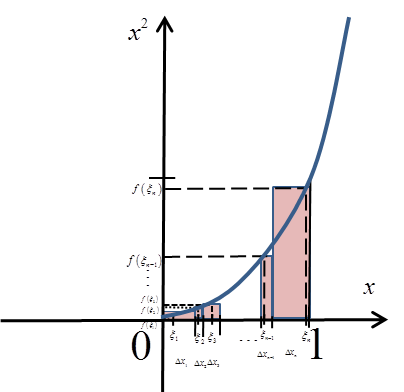 we would obtain a completely different integral sum:
\underset{n\to \infty }{\mathop{\lim }},\sum\limits_{k=1}^{n}{f\left( {{\xi }{k}} \right)}\Delta {{x}{k}}
and nowhere is it stated (at least for now) that it would turn out to be equal to \frac{1}{3}.
we would obtain a completely different integral sum:
\underset{n\to \infty }{\mathop{\lim }},\sum\limits_{k=1}^{n}{f\left( {{\xi }{k}} \right)}\Delta {{x}{k}}
and nowhere is it stated (at least for now) that it would turn out to be equal to \frac{1}{3}.
Uselessness of the “pure” definition
So, if we stay strictly within the definition itself, I would have to compute all possible integral sums—or somehow prove that they are equal. Impossible.So what should we do?
We need to keep learning (hooray!) and introduce additional theorems. Such a theorem was precisely the theorem on the integrability of a continuous function from Lecture 2. Helpful in its proof—and useful in taming this overwhelming “freedom” of integral sums \underset{n\to \infty }{\mathop{\lim }},\sum\limits_{k=1}^{n}{f\left( {{\xi }{k}} \right)}\Delta {{x}{k}}—are Darboux sums, the topic of this lecture. These are simply special integral sums obtained for strictly selected points {{\xi }_{k}}.A note on bounds
Before we go any further, be sure to recall what bounds (infimum, supremum, etc.) are. It’s best to work through a few examples. I invite you to watch my VIDEO on bounds: Bounds – but in mathematicsDarboux Sums
The name of these integral sums comes from Gaston Darboux, the gentleman from the photo at the beginning of the lecture. Not more than 150 years ago (so not that long ago, you’ll probably agree), from the jungle of all possible integral sums and all possible choices of points {{\xi }_{k}}, he selected one approach that strictly and uniquely defines the definite integral. One is definitely better than infinitely many in this case—so he gets the point. So how are Darboux sums defined?Lower Darboux sums
Let’s start with the lower integral sum:- I take an arbitrary partition of the interval \left\langle a,b \right\rangle into subintervals \Delta {{x}_{k}}
- Instead of choosing the points {{\xi }_{k}} arbitrarily, I choose them so that in each subinterval \Delta {{x}_{k}} the value f\left( {{\xi }_{k}} \right) is the lower bound of the function on that interval (for continuous functions this is the same as the minimum value of the function)
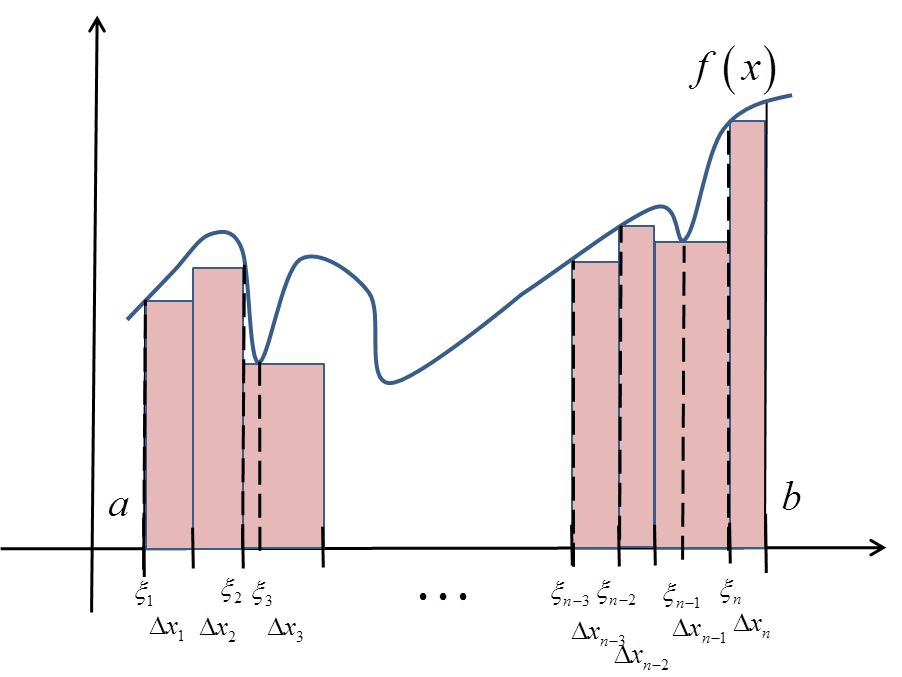 Notice that the points: {{\xi }{1}},{{\xi }{2}},\ldots ,{{\xi }{n}} inside the intervals: \Delta {{x}{1}},\Delta {{x}{2}},\ldots ,\Delta {{x}{n}} are chosen so that the function f\left( x \right) reaches its smallest value (i.e. the lower bound, since the function is continuous) in each interval.
And what’s the deal with these “bounds”?
Here comes a small side remark: we must use the term bounds, not minimum/maximum values, in order to make the definition work also for certain discontinuous functions, for example: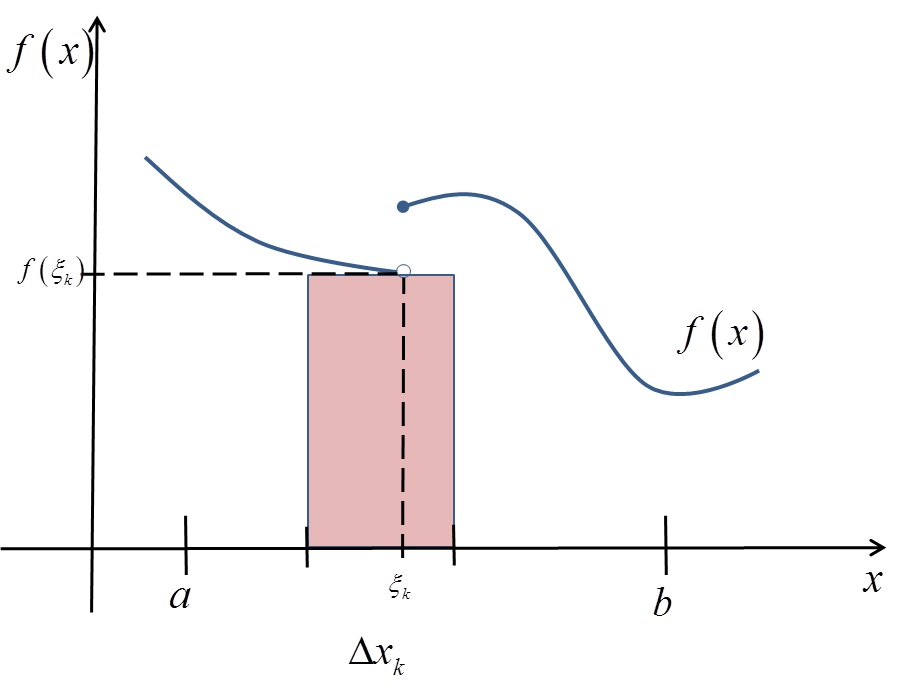 Here you can see that the function is discontinuous inside a certain interval \Delta {{x}_{k}}, yet there is no problem determining the area between its graph and the interval \left\langle a,b \right\rangle using the “rectangles” method and integral sums.
The problem would arise when trying to determine its lower integral sum: within the interval \Delta {{x}_{k}} it does NOT attain a smallest value. However, it does have a LOWER BOUND there, which is why the definition of lower Darboux sums uses bounds instead of minimum/maximum values.
You can find the difference between the two in my post—have a look: What are bounds?
Now back to our lower integral sums.
Here you can see that the function is discontinuous inside a certain interval \Delta {{x}_{k}}, yet there is no problem determining the area between its graph and the interval \left\langle a,b \right\rangle using the “rectangles” method and integral sums.
The problem would arise when trying to determine its lower integral sum: within the interval \Delta {{x}_{k}} it does NOT attain a smallest value. However, it does have a LOWER BOUND there, which is why the definition of lower Darboux sums uses bounds instead of minimum/maximum values.
You can find the difference between the two in my post—have a look: What are bounds?
Now back to our lower integral sums.
Lower Darboux sums bound all integral sums from below
The points {{\xi }_{k}} are chosen so that in each interval \Delta {{x}_{k}} the function reaches its lower bound. Geometrically, this means that the rectangle with area {{\xi }_{k}}{{\Delta }_{k}} is the smallest possible (has the smallest area) among all rectangles that could be formed. Therefore, it is obvious that the integral sum made of these smallest possible rectangles for a given partition \Delta {{x}{k}} is LESS THAN OR EQUAL TO any other integral sum for that partition. Geometrically—the sum of the areas of the smallest possible rectangles for a given partition \Delta {{x}{k}} is always less than or equal to any other sum of rectangle areas for that partition. Denoting lower Darboux sums by {{S}_{*}}, and any other integral sum by S, we always have: {{S}_{*}}\le S Moreover—once a partition \Delta {{x}{k}} is fixed—the sum {{S}{*}} is a fixed, uniquely determined number, while the sum S depends on the choice of the points {{\xi }_{k}}.Upper Darboux sums
Now you can probably guess what happens next, right?- I take an arbitrary partition of the interval \left\langle a,b \right\rangle into subintervals \Delta {{x}_{k}}
- Instead of choosing the points {{\xi }_{k}} arbitrarily, I choose them so that in each subinterval \Delta {{x}_{k}} the value f\left( {{\xi }_{k}} \right) is the upper bound of the function on that interval (for continuous functions this is the same as the maximum value of the function)
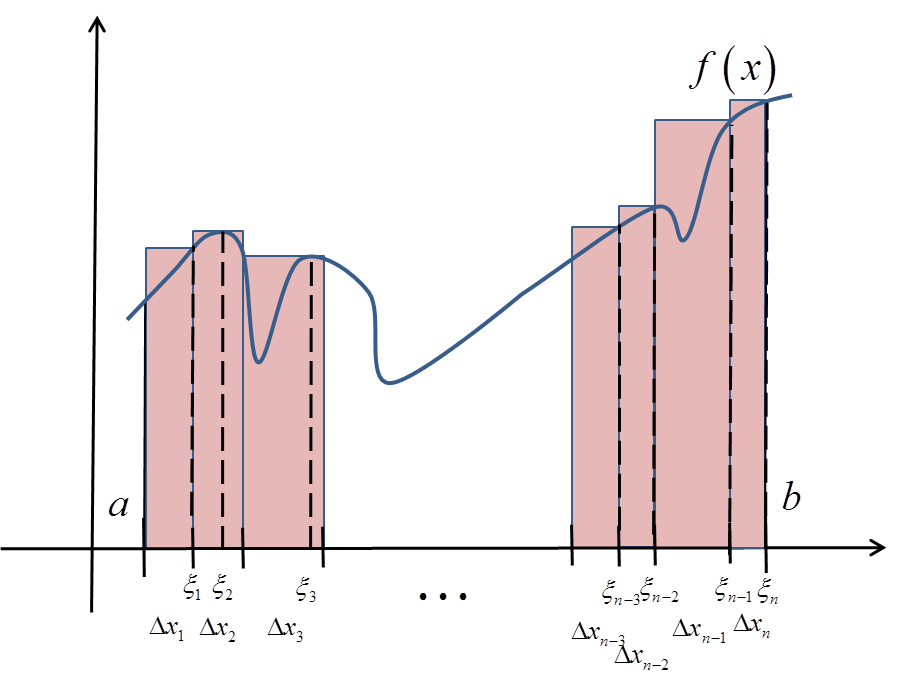 Now notice that the points: {{\xi }{1}},{{\xi }{2}},\ldots ,{{\xi }{n}} inside the intervals: \Delta {{x}{1}},\Delta {{x}{2}},\ldots ,\Delta {{x}{n}} are chosen so that the function f\left( x \right) reaches its greatest value (i.e. the upper bound) in each interval.
This time the rectangles have the largest possible areas for the given partition \Delta {{x}_{k}}, and their sum…
Now notice that the points: {{\xi }{1}},{{\xi }{2}},\ldots ,{{\xi }{n}} inside the intervals: \Delta {{x}{1}},\Delta {{x}{2}},\ldots ,\Delta {{x}{n}} are chosen so that the function f\left( x \right) reaches its greatest value (i.e. the upper bound) in each interval.
This time the rectangles have the largest possible areas for the given partition \Delta {{x}_{k}}, and their sum…
Upper Darboux sums bound all integral sums from above
Just as in the previous case, it is obvious that the sum of the areas of the largest possible rectangles is an upper bound for any other sum of rectangle areas (for a given partition \Delta {{x}_{k}}). Denoting the upper Darboux sums by {{S}^{*}} and any other possible sum (for the partition \Delta {{x}_{k}}) by S, we have: S\le {{S}^{*}} Here again—once the partition \Delta {{x}_{k}} is fixed— {{S}^{*}} is a number, while S is a variable.Darboux integral sums are lower and upper bounds of integral sums
So (combining the inequalities), we have: {{S}_{}}\le S\le {{S}^{}} As for arbitrary integral sums S, since we can freely “shift” the points {{\xi }{k}} in them so as to obtain values of S that also reach {{S}{}} and {{S}^{}}, this means that {{S}_{}} and {{S}^{}} are the greatest/least possible lower/upper bounds. In other words—directly from the definition—they are the lower and upper bounds of integral sums on a given interval. More “practically”: If I were to:- Compute an integral sum from the definition
- Have a partition by subintervals \Delta {{x}_{k}} fixed in advance
- Choose the points {{\xi }_{k}} so as to obtain the lower Darboux sum
- Compute that sum and obtain, say, 13
- Know that any other integral sum for this partition \Delta {{x}_{k}} is equal to 13 or greater
What still can’t I say?
Unfortunately, at this stage I still cannot say: “If the lower Darboux sum turned out to be 13, then the definite integral is equal to 13 or more.” Why? Because of that annoying catch: “for a fixed partition \Delta {{x}_{k}}”. How did I construct Darboux sums? I assumed that I had a GIVEN, fixed partition of the segment \left\langle a,b \right\rangle into subintervals \Delta {{x}{k}}. Within those fixed subintervals I chose the points {{\xi }{k}} so as to obtain the bounds (lower or upper) of the values f\left( {{\xi }_{k}} \right). So all bounds of integral sums, whether from below or above, apply only to that GIVEN PARTITION \Delta {{x}{k}}. If the lower Darboux sum for a certain partition \Delta {{x}{k}} equals 13, it means that all other integral sums are greater than or equal to 13—but ONLY FOR THAT PARTITION. If I divide the segment \left\langle a,b \right\rangle into subintervals \Delta {{x}_{k}} in a different way, perhaps one of the integral sums will turn out to be 10. At least that’s how it looks at this stage, right? So at this point I cannot say that Darboux sums in any way bound the definite integral, because in the definition of the definite integral there was freedom in choosing the subintervals \Delta {{x}_{k}}.That’s not great—what next (Darboux integrals)?
Next, as always—I don’t lose heart, but introduce new properties that will allow us to bound the integral using Darboux sums—the so-called Darboux integrals.Property 1
Take any fixed partition of the segment \left\langle a,b \right\rangle into subintervals \Delta {{x}_{k}}. If any of these subintervals \Delta {{x}_{k}} are further subdivided into smaller ones, this does not decrease the lower Darboux sum nor increase the upper one. The matter is quite obvious geometrically. Taking any rectangle, for example corresponding to \Delta {{x}_{3}}, you can see what is going on: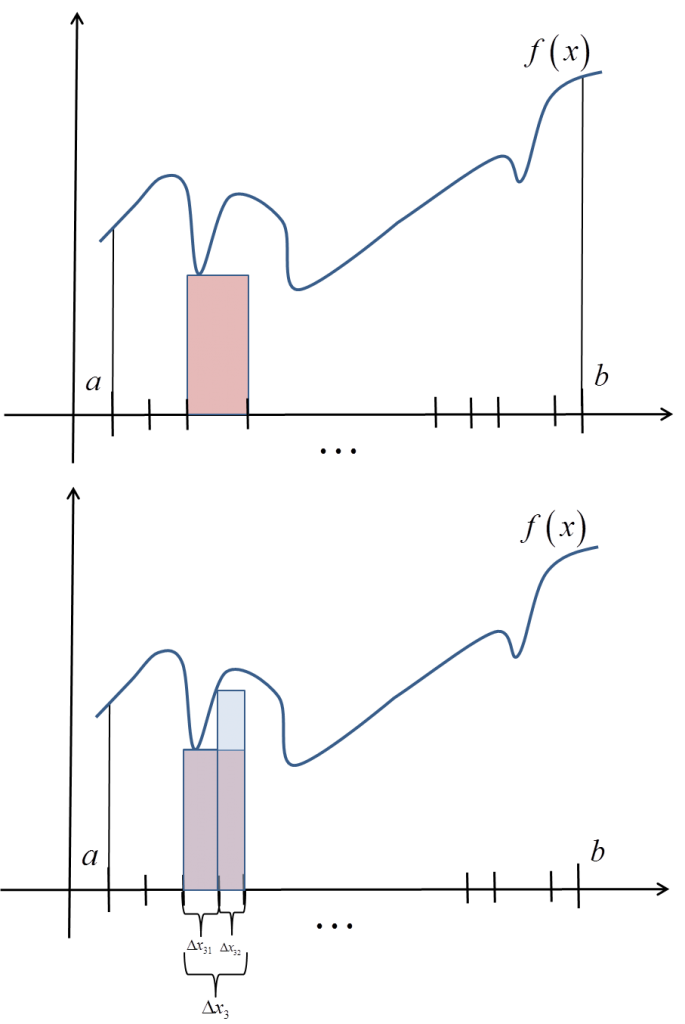 If we subdivide a subinterval, the sum of the areas of the resulting rectangles will certainly not be SMALLER than before the subdivision.
Property 2
Any lower Darboux sum (for any partition \Delta {{x}_{k}}) is less than or equal to any upper Darboux sum. This is already a strong property, because it no longer restricts me to a fixed partition \Delta {{x}{k}}. If for some partition by subintervals \Delta {{x}{k}} the lower Darboux sum equals 13, then for any other partition its upper Darboux sum certainly cannot be 12, but at least 13.Proof of Property 2
- I have the interval \left\langle a,b \right\rangle .
- I take some arbitrary partition into subintervals \Delta {{x}_{k}}. For this partition I have a lower and an upper Darboux sum. I denote them (respectively) by {{s}_{1}} and {{S}_{1}}.
- I take another completely arbitrary partition (with different subintervals \Delta {{x}_{k}}). For it I also have a lower and an upper Darboux sum. I denote them by {{s}_{2}} and {{S}_{2}}.
Darboux integrals
What follows from Property 2? If I take all possible lower Darboux sums, there exists some number that they never exceed (for example, any upper Darboux sum). So this set has an upper bound (not necessarily an upper Darboux sum itself—it is only a bound from above!). Let us denote it by {{I}_{*}}. Analogously—the set of all possible upper Darboux sums has its lower bound, and I denote it by {{I}^{*}}. I call the number {{I}_{}} the lower Darboux integral, and the number {{I}^{}} the upper Darboux integral. If by {{S}^{}} and {{S}_{}} we denote any lower and upper Darboux sums, we have: {{S}{*}}\le {{I}{}}\le {{I}^{}}\le {{S}^{*}} The inequality {{I}_{}}\le {{I}^{}} follows directly from Property 2.Star of the evening – the condition for the existence of the definite integral using Darboux sums
Now we’re ready for the finale. After a long preparation, we can define the definite integral using Darboux sums (and not the very arbitrary integral sums as in Lecture 1).Where {{S}^{}} and {{S}_{}} are the upper and lower Darboux sums for an arbitrary partition \Delta {{x}_{k}}, and n is the number of subintervals tending to infinity, as in the definition of the definite integral.Theorem
For the definite integral to exist, it is necessary and sufficient that: \underset{n\to \infty }{\mathop{\lim }},\left( {{S}^{}}-{{S}_{}} \right)=0
Proof
The proof has to be carried out “in two directions,” i.e., we must prove necessity and sufficiency of the condition (“necessary and sufficient”).“necessity”
In this case I ASSUME that the definite integral exists (defined as in Lecture 1), and I must show that then: \underset{n\to \infty }{\mathop{\lim }},\left( {{S}^{}}-{{S}_{}} \right)=0 Here the matter is obvious. Since by assumption I know that the definite integral exists, I also know that for any partition into subintervals \Delta {{x}{k}} and any choice of points {{\xi }{k}} the integral sum equals the same number. Therefore the Darboux sums {{S}^{}} and {{S}_{}} are equal (more precisely: they tend to the same number) simply by the assumption, and of course: \underset{n\to \infty }{\mathop{\lim }},\left( {{S}^{}}-{{S}_{}} \right)=0“sufficiency”
In this case I ASSUME that \underset{n\to \infty }{\mathop{\lim }}\,\left( {{S}^{*}}-{{S}_{*}} \right)=0 and I must show that then the definite integral (defined as in Lecture 1) exists. I will use here the Darboux integrals (defined above) {{I}_{}} and {{I}^{}}. As you remember (above): {{S}{*}}\le {{I}{}}\le {{I}^{}}\le {{S}^{*}} In our case we additionally assume that: \underset{n\to \infty }{\mathop{\lim }},\left( {{S}^{}}-{{S}_{}} \right)=0. It follows from this (e.g. by the squeeze theorem) that: {{S}{*}}\le {{I}{}}={{I}^{}}\le {{S}^{*}} And denoting the common value {{I}_{}}={{I}^{}} by a single number I: {{S}_{}}\le I\le {{S}^{}} I also know that for any fixed partition \Delta {{x}{k}}, the sums {{S}^{*}} and {{S}{*}} are the upper and lower bounds of all integral sums for this partition (as I showed above). That is, if we denote any integral sum for this partition by S, then: {{S}_{}}\le S\le {{S}^{}} Since \underset{n\to \infty }{\mathop{\lim }},\left( {{S}^{}}-{{S}_{}} \right)=0, then—stating this very precisely (from the definition of the limit of a sequence)—for any arbitrarily small \varepsilon we can find such an index n from which the distance between {{S}^{}} and {{S}_{}} is smaller than \varepsilon . The numbers I and S belong to the interval \left\langle {{S}_{}},{{S}^{}} \right\rangle , and it is obvious that the distance between them will then also be smaller than that \varepsilon . Therefore I and S converge to the same limit, i.e., any integral sum S converges to the same number ( I)—so, according to the definition in Lecture 1, the definite integral exists.The Darboux condition as “oscillation”
The condition for the existence of the definite integral is: \underset{n\to \infty }{\mathop{\lim }},\left( {{S}^{}}-{{S}_{}} \right)=0 written out, it would look like this: \underset{n\to \infty }{\mathop{\lim }},\left( \sum\limits_{k=1}^{n}{f\left( \xi {k}^{*} \right)\Delta {{x}{k}}}-\sum\limits_{k=1}^{n}{f\left( {{\xi }{k}}{*} \right)\Delta {{x}_{k}}} \right)=0 Where f\left( \xi {k}^{*} \right) and f\left( {{\xi }{k}}{*} \right) are the upper and lower bounds of the function on the k-th subinterval \Delta {{x}{k}} (as in the definitions of Darboux sums above). It can be written as: \underset{n\to \infty }{\mathop{\lim }},\left( \sum\limits_{k=1}^{n}{f\left( \xi {k}^{*} \right)\Delta {{x}{k}}}-\sum\limits_{k=1}^{n}{f\left( {{\xi }{k}}{*} \right)\Delta {{x}_{k}}} \right)=0 \underset{n\to \infty }{\mathop{\lim }},\sum\limits_{k=1}^{n}{\left( f\left( \xi {k}^{*} \right)-f\left( {{\xi }{k}}{*} \right) \right)\Delta {{x}{k}}}=0 And if we denote {{\omega }{k}}=f\left( \xi {k}^{*} \right)-f\left( {{\xi }{k}}{*} \right): \underset{n\to \infty }{\mathop{\lim }},\sum\limits_{k=1}^{n}{{{\omega }{k}}\Delta {{x}{k}}}=0 where {{\omega }{k}} denotes the “oscillation” (something like the “amplitude”) of the function on the given subinterval \Delta {{x}{k}}.Summary
Darboux sums are used to prove the integrability theorem (you already know one from Lecture 2, but without proof), which I will show you in the next lecture. Only with these theorems can one actually compute definite integrals from the definition in practice—so the significance of Mr. Darboux’s “discovery” is not small.THE END
While writing this post I used…
1. “Differential and Integral Calculus. Volume II.” G.M. Fichtenholz. Ed. 1966.
Click here to review how to compute definite integrals from the definition using the theorem on integrability of a continuous function (previous lecture) <-- Click here to return to the page with the lectures on definite integrals