

Cyclometric Functions Lecture
Topic: Cyclometric functions
Summary
During the lecture I will introduce the concept of cyclometric functions: arcsinx, arccosx, arctgx, arcctgx. These are inverse functions to trigonometric functions.
The lecture consists of two parts. In the first one, I only show how to quickly calculate the values of trigonometric functions, without going too deep into the topic (this part is accompanied by a video, a fragment of my Course on Definite Integrals, Improper Integrals and Applications of Integrals ).
In the second one, I describe cyclometric functions more precisely, show their graphs, etc.
To understand the lecture you will need:
- trigonometric functions (high school)
Part I
Cyclometric functions – „INSTANT” version
Cyclometric functions „in common sense” are simply the opposite of trigonometric functions. So arcsinx is the inverse function of sinx.
That is, if, for example, we know that , it means that
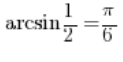 .
.
And so on:
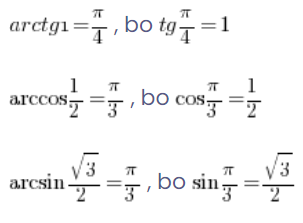
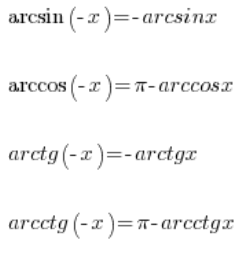
In addition, we have a few properties of trigonometric functions that allow us to calculate their values also for negative arguments:
So we can also calculate this:
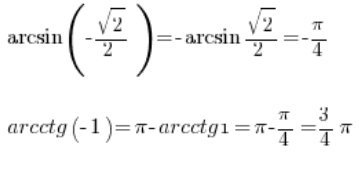
So, if we have a table of trigonometric functions, we can easily determine the values of cyclometric functions from it, simply by reading it „the other way around”.
I explain it in more detail here in the video:
Table of basic values of trigonometric functions from the video – download here .
Part II
Cyclometric functions – full version
Introduction – why part I is not enough
So it looks like in Part I we defined each cyclometric function as the inverse of its corresponding trigonometric function.
Let’s formalize this a bit. We said, for example, a function takes a value
 when function
 from this is equal
 .
.
Appropriately:
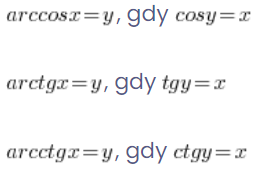
That is, if we want to calculate we wonder what the cosine of the angle gives
 , we realize that it is an angle
 and we have the result:
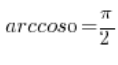 .
.
Does this exhaust the topic of the values of cyclometric functions?
Of course NO .
Let’s look at the whole reasoning again using specific numbers (and maybe traditionally switch to arcsinx):
If we want to calculate we wonder what the sine of the angle gives
 , we realize that it is an angle
 and we have the result:
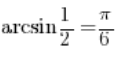 .
.
Where’s the problem? In the bolded part:
If we want to calculate we wonder what the sine of the angle gives , we realize that it is an angle and we have the result: .
Unfortunately, not only sine is equal .
Let’s recall the graph of the sinx function (I marked the value on it ):
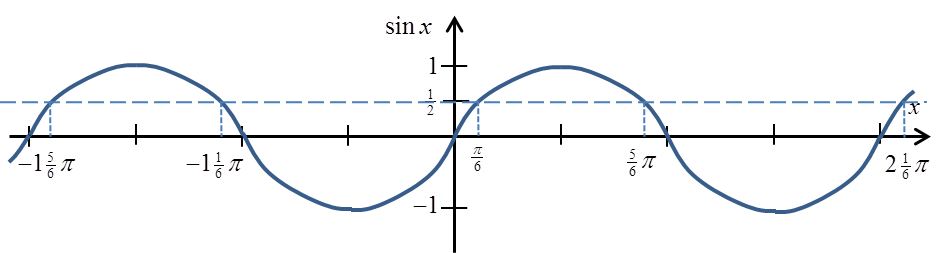
You can see and we already know it from high school that the sine reaches a value not just for the angle , but also for angles: 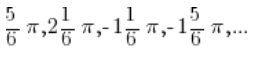
That is 
So let’s recall once again our way of calculating arcsin:
If we want to calculate we wonder what the sine of the angle gives , we realize that it is an angle and we have the result: .
Well, now we know that it’s not just sin gives , so it looks like:

This would mean that arcsinx is not a function at all, because one argument has several values assigned to it!
Giving a clear answer to the question of what the arcsin of something is would then be completely impossible.
It is also easy to imagine that a similar problem applies to EACH trigonometric function.
To put it more professionally: these functions are not one-valued, so inverse functions do not exist. In each of the trigonometric functions, each of their values is reached for an infinite number of arguments (they are periodic, right?), so when we try to determine their inverse functions, we will get an infinite number of values assigned to each argument. And this cannot be the case in functions.
What to do?
It’s quite simple, not to mention vulgar. Each trigonometric function can be TRUNCATED to obtain a one-valued function.
Let’s get started, let’s define all 4 cyclometric functions correctly:
arcsinx
Let us recall the graph of the sinx function:
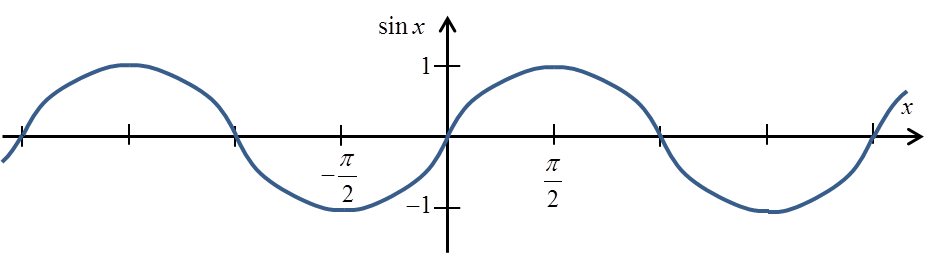
If we agree to cut it, for example, to a compartment , we will get a chart like this:
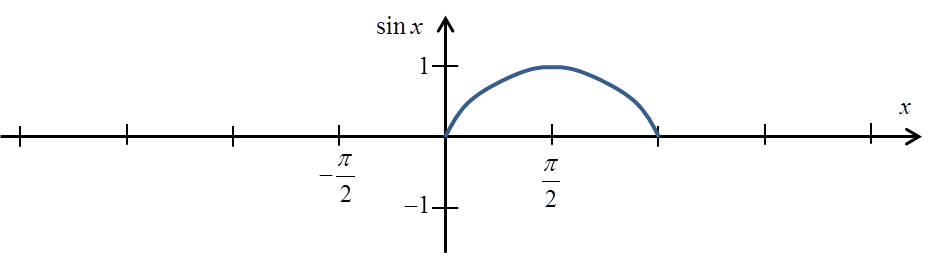
Unfortunately, this is not what we want, because there is no graph of a one-valued function and a problem with the value, e.g. still occurs:
![Graph of the sinx function in the interval [0,pi] with the value 1/2 marked](https://blog.etrapez.pl/wp-content/uploads/sites/3/2012/01/Obraz41.png "Graph of the sinx function in the interval [0,pi] with the value 1/2 marked")
So we agree that we will trim the sinx function differently, to the arguments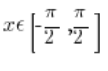 : :
: :
![Graph of the sinx function for x belonging to [-pi/2,pi/2]](https://blog.etrapez.pl/wp-content/uploads/sites/3/2012/01/Obraz51.png "Graph of the sinx function for x belonging to [-pi/2,pi/2]")
Now it is a one-valued function and there is an inverse arcsinx function to it.
The graph of the arcsinx function will look something like this:

Its domain is the interval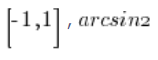 does not exist.
The precise definition of the arcsinx function is therefore:
 .
.
arccosx
The cosx function is also not a differentiable function:
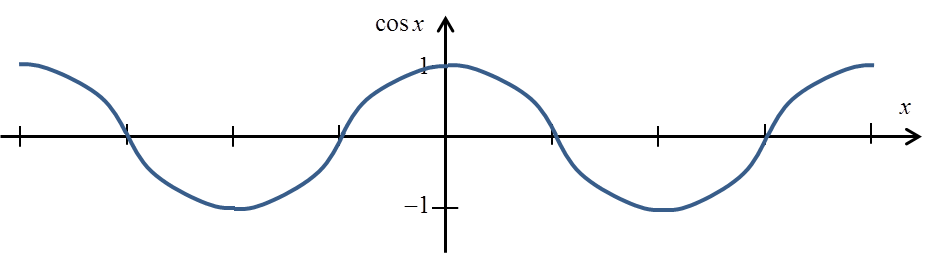
However, to obtain a one-valued function, we must trim it to an interval : :
![Graph of the cosx function truncated to the interval [0,pi]](https://blog.etrapez.pl/wp-content/uploads/sites/3/2012/01/Obraz8.png "Graph of the cosx function truncated to the interval [0,pi]")
The function defined in this way is already one-valued and has the inverse function arccosx.
Its graph will be approximately:
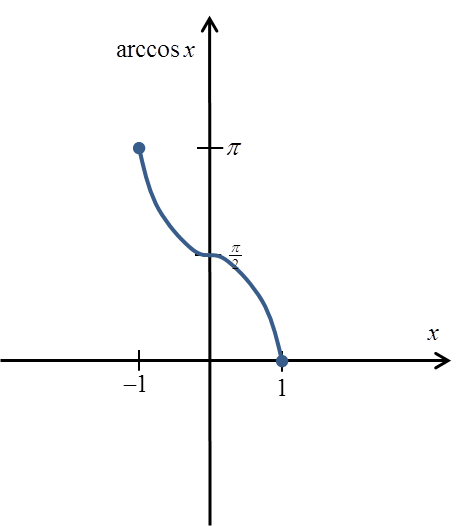
And its strict definition:
 .
.
arctgx
The tgx function graph looks like this:
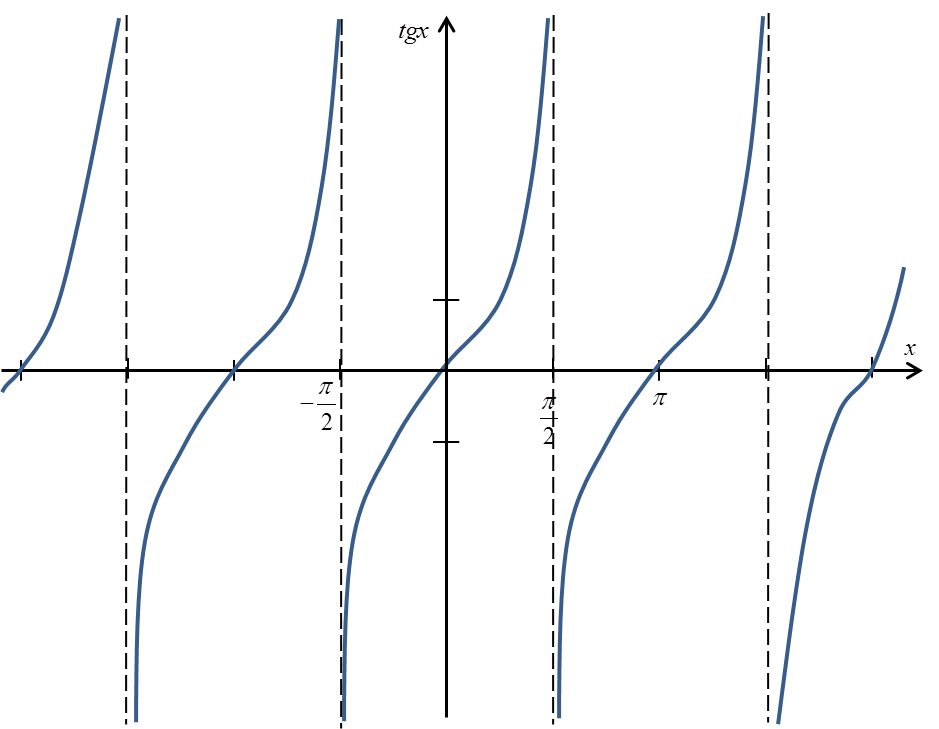
Also not a one-valued function! We can cut it as follows:
![Graph of the tgx function limited to the range [-pi/2,pi/2]](https://blog.etrapez.pl/wp-content/uploads/sites/3/2012/01/Obraz111.png "Graph of the tgx function limited to the range [-pi/2,pi/2]")
Thus obtaining a one-valued function.
The arctgx function graph looks like this:
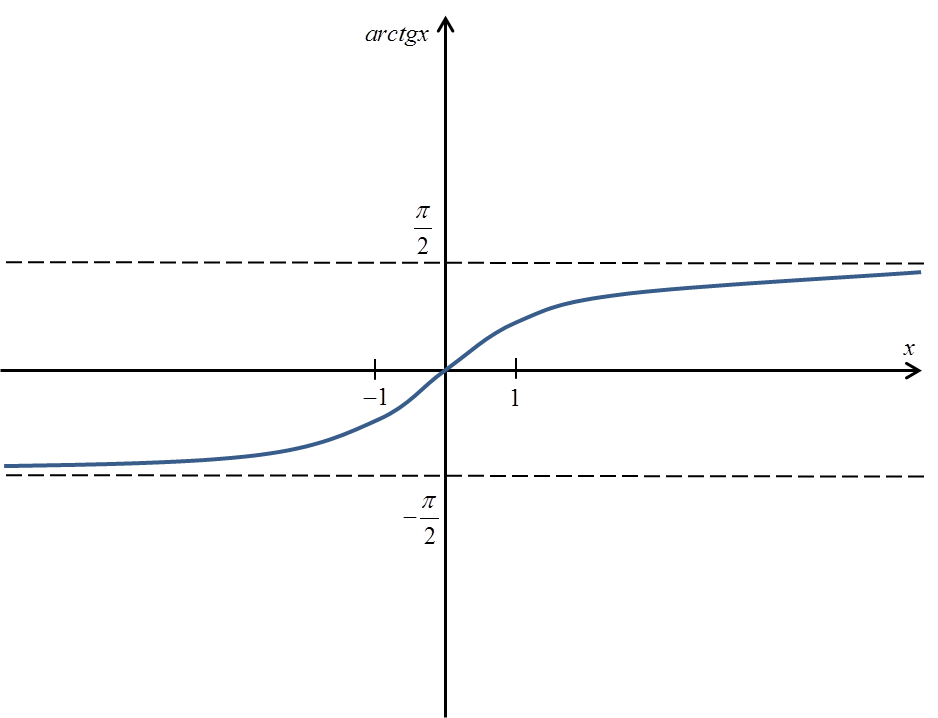
And its precise definition is as follows:
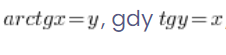 , for y\in \left( -\frac{\pi }{2} ,\frac{\pi }{2} \right) .
Let’s also note that the graph shows some interesting properties, e.g.:
- the domain of the arctgx function is the entire set of real numbers (we can calculate arctg from each number)

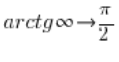
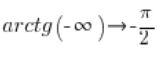
arcctgx
From the ctgx function graph:
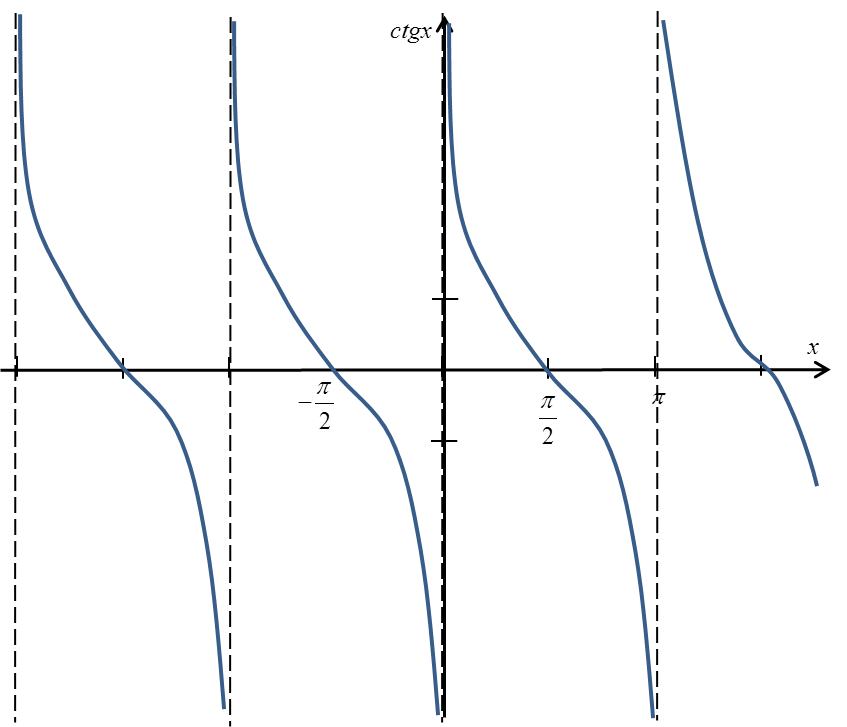
We cut out a multi-valued piece:

The arcctgx function graph looks like this:
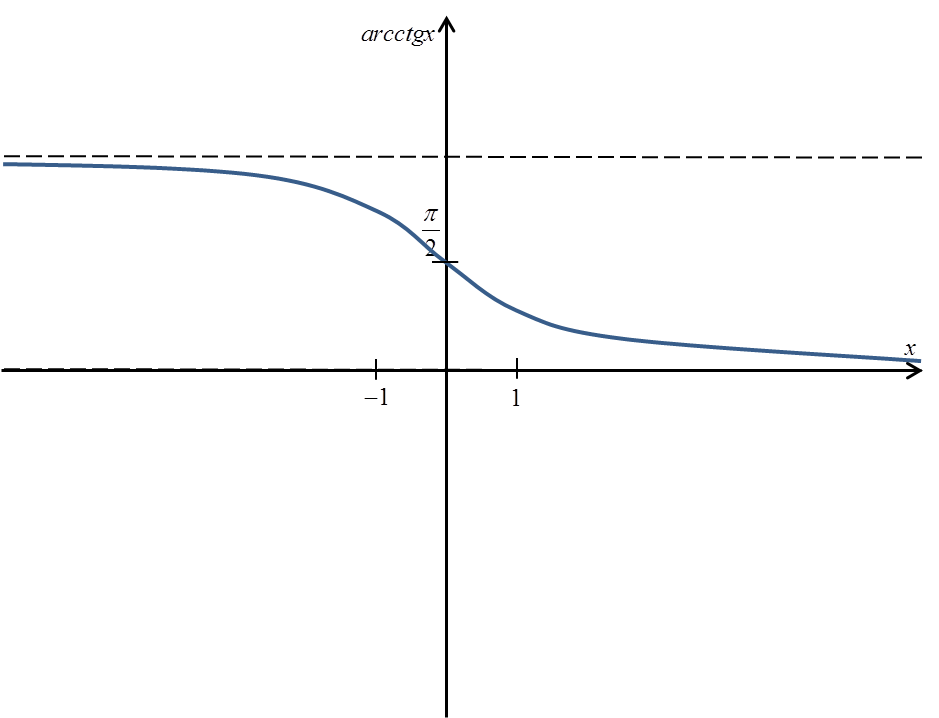
A precise definition of arcctgx would be:
 .
.
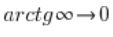
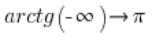
It seems:
- the domain of the arcctgx function is the entire set of real numbers (we can calculate arcctg from each number)
Attention
In many calculators and mathematical notations in general (especially Western ones), inverse trigonometric functions are not marked as „arcus”, but with an exponent of -1. For example, arcsinx is written as . If you know what you’re talking about, there’s no problem. However, you can make a terrible mistake and confuse the inverse of sinx with a function
 – which is a completely different function from arcsinx.