
Limit of a sequence Lecture 2
Topic: Determining the limit of a sequence by definition
Summary
In the article I will show how in practice you can „feel” the definition of the limit of a sequence using specific examples. Let’s recall the definition of the limit of a sequence:
Definition of a sequence boundary
The number g is called the limit of a sequence if and only if:
\underset{\varepsilon >0}{\mathop{\forall }}\,\underset{N}{\mathop{\exists }}\,\underset{n>N}{\mathop{\forall }}\,\left| {{a}_{n}}-g \right|<\varepsilonThe idea was that for any small, chosen in advance, epsilon ( \varepsilon ), we will find the number of the sequence term ( N ) that all words with consecutive numbers greater than N ( n> N ) will have a distance from the boundary g smaller than epsilon ( \left| {{a} _{n} }-g \right|< \varepsilon ) – no matter how small this fixed epsilon is.
Difficult? Well, of course it’s difficult. It takes practice to understand. We will see how it works with examples.
Example 1 for calculating which term of a sequence satisfies the inequality for a given epsilon
Given a sequence with a general term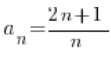 and border
 . For epsilon equal
 – which terms of the sequence satisfy the inequality
 ?
?
In the problem, we set the epsilon to 0.017. We need to calculate from which term the distances of the sequence terms from the limit will be smaller than 0.017. Get out your calculator, OK?
First, very slowly, we’ll figure out what’s going on…
Our sequence written word by word would look like this:

I obtain subsequent words by substituting a for specific numbers. Putting it in order, I will have:
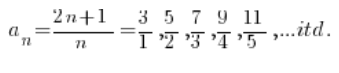
That is:
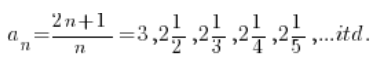
The subsequent terms of the sequence will be closer and closer to the number 2. Our task is to find the number of the sequence term from which the distances from two will be smaller than the given ones .
It certainly won’t be the first word. It is equal to 3. Its distance from the border (g=2) is equal to 1! This is much more than requested .
It will not be the second term either (distance=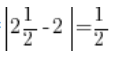 , i.e. less than ), nor any of the first five I wrote.
It will not be the fiftieth term, because it is equal , and its distance from 2 is 0.02, which is still greater than the given value .
However, the hundredth term satisfies the given condition, because , its distance from two is equal to 0.01, which is less than 0.017. However, there are words with numbers less than 100 that also meet this condition. Our task is to find the limit number from which the distance of the terms of the sequence from 2 is less than 0.017. Since the distance of the fiftieth term does not meet the condition but the hundredth one does, it seems that it will be some term between the fiftieth and the hundredth… How to find it exactly?
Let’s remember the definition…
\underset{\varepsilon >0}{\mathop{\forall }}\,\underset{N}{\mathop{\exists }}\,\underset{n>N}{\mathop{\forall }}\,\left| {{a}_{n}}-g \right|<\varepsilonAnd the inequality that comes with it…
 from this definition it is the general term of the sequence, in our example it is equal to .
 we have it predetermined , and the limit of g is 2. We put all this into the inequality and we have:
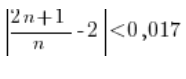
We reduce the absolute value in the middle to a common denominator:
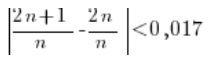
We subtract and we have:
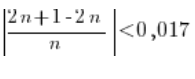
That is:
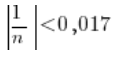
Now it’s a little harder. On the left side of the inequality in the middle of the absolute value we have . This expression is always positive because n stands for the number of the sequence and we take numbers such as: 1, 2, 10. So we have the absolute value of a positive number. We can therefore leave it out, because the absolute value of a positive number is always positive:
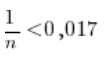
We multiply both sides by n, again we must remember that 'n’ is always positive and it will not change the sign of the inequality. After multiplying both sides, we get:
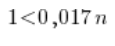
Now we divide both sides by 0.017 (we use a calculator and take some reasonable approximation).
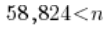
Looking at this inequality and remembering that 'n’ stands for the number of the term in the sequence – what will be the answer?
Answer
All terms of the sequence numbered from 59 upwards satisfy the inequality. In this sequence, the distance of the 58th term from 2 is not smaller than the given epsilon, but the 59th, 60th, 61st,… and each subsequent one is.
Example 2 for calculating which term of the sequence satisfies the inequality for a given epsilon
Given is a sequence with a general term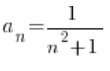 and border
 . For epsilon equal
 – which terms of the sequence satisfy the inequality ?
This example is very similar to the previous one. We have Epsilon set to . We need to calculate from which term the distances of the sequence terms from the boundary will be smaller than this value.
Let’s break down the sequence:

That is…
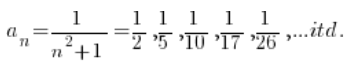
The terms of the sequence become smaller and smaller, approaching zero. You need to determine which ones have this distance smaller than .
It won’t be that easy again, you can see that it won’t be any of the first five words. Let’s get straight to the point…
We insert the appropriate values into the inequality by definition:
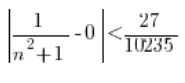
That is…
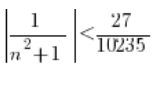
We can leave the absolute value again because is always positive, so we can write:
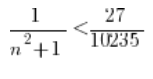
We can multiply both sides by , because is always greater than zero…
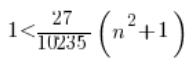
We multiply both sides by 10235 (to make it easier) and we have:
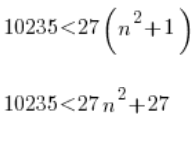
We move 27 to the left:
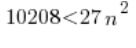
We divide both sides by 27 (calculator) and approximately:
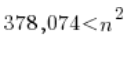
'n’ can only be positive (it makes life easier, right?) so we can write:
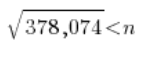
So approximately:
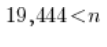
So we have:
Answer
All terms of the sequence starting from the 20th satisfy the inequality.
Example 1 for calculating the limit of a sequence by definition
Let’s do another task in which we will have to dig into the definition of the limit of the sequence:
Show by definition that the limit of a sequence is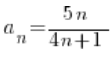 is the number
 .
.
Using the definition, it is necessary to show that for any arbitrarily small there was a number of terms in the sequence from which subsequent terms would satisfy the inequality:
And in our specific example, we need to show that for any small epsilon for all n starting from some the inequality will be satisfied:
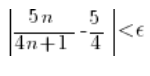
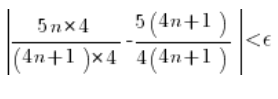
We will do this by determining 'n’ from the above inequality. First, let’s reduce it to a common denominator…
After some light cleaning:
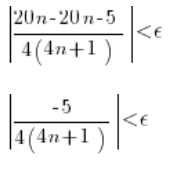
We can break down this absolute value on the left – for example – like this:
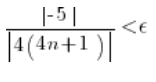
That is:
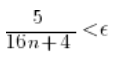
We can multiply both sides by (because it is always positive).
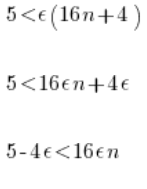
We divide both sides by (we can, because in the definition of the limit is always positive):

And now: n are the numbers of the words in the sequence. They are getting bigger and bigger. Any If we determine the left side of the inequality, we will get some constant number there. Even if it was very large, however, as n grows and grows, eventually the right side of the inequality will „jump over” the left side and from some n onward the inequality will be satisfied, regardless of the choice. .
So we showed by definition what we were supposed to show.
Finally, let’s do an example the other way around…
Example 2 for calculating the limit of a sequence by definition
Check from the definition whether the limit of the string , Where
 is greater than 1, there is a number
 .
.
Let’s pay attention to a nuance. In the previous example, the text of the task was „Prove that…” – that is, it was known in advance that that number was the limit of the sequence and it only needed to be proven. Here we have „Check if…” – so perhaps our number will not be the limit of the sequence at all.
We start with inequality by definition…
To which we substitute appropriate values…
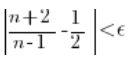
We try again to determine 'n’ from the above inequality.
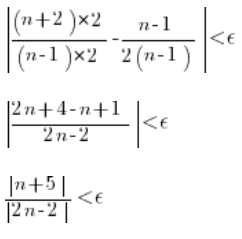
Absolute values can be omitted because – pay attention to the text of the problem – it is said that , i.e. the absolute value at the bottom is calculated from a positive number.

We multiply both sides by the denominator (for the same reasons we left out the absolute value):
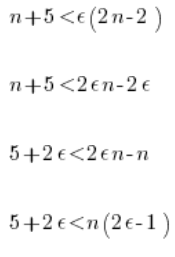
By We cannot divide it like that because for certain values the expression is positive, and for some the expression is negative. If we agreed for example, a very tiny (we can, because it could be anything) expression will be negative and after dividing both sides by: (remember to change the sign of the inequality after multiplying both sides by a negative value!):

So we have (due to the reversed inequality sign) a completely opposite situation than in the previous example. On the left there is a fixed number. On the right, the numbers are getting bigger and bigger. It can be stated that from certain ns the inequality will NOT be fulfilled (and it was supposed to be fulfilled for any epsilon).
Therefore, the number from the problem is not the limit of the sequence.
Click to recall the definition of the limit of a sequence (previous Lecture)< —
Click to learn more about undefined expressions (next Lecture) –>