
Limits of functions Lecture 8
Topic: Limit of a function{lim} [pmath]under{x[/pmath]{right} [pmath]0}[/pmath]{sinx} [pmath]/x=1[/pmath] – proof
Summary
In the article I will show proof that:
[pmath]{lim}under{x{right} 0}{sinx} /x=1[/pmath]
I didn’t come up with the proof myself, I just took it from GMFichtenholz’s book „Differential and Integral Calculus” (with a small modification at the very end) – of course extending it to include all transitions, for a better understanding of what comes from what. To demonstrate the above limit, I will use Cauchy’s definition of the limit of a function.
Demonstrating a certain inequality useful for proof
Lemma
For [pmath]0[/pmath]< [pmath]x[/pmath]< [pmath]1/2[/pmath] :
[pmath]sinx[/pmath]< [pmath]x[/pmath] and [pmath]x[/pmath]< [pmath]tgx[/pmath] .
Evidence
So we will prove the inequality:
[pmath]sinx< x< tgx[/pmath], which occurs for [pmath]0< x< 1/2[/pmath]
This inequality is worth remembering, it is useful not only for this proof, but for various other things in mathematical analysis (for example, for estimating numerical series in a comparative criterion). Besides, it’s interesting in itself, right? 🙂
Let’s go ahead and prove this inequality.
First, let’s draw something like this:
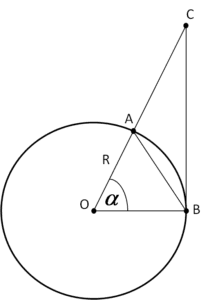 We have a circle with center O, radius R, chord AB, angle AOB equal to [pmath]alpha[/pmath] , and tangent BC to the circle at point B.
Let’s note three things:
- Area of triangle OAB
- Area of a sector of a circle with angle [pmath]alpha[/pmath] AOB (do not confuse it with the triangle from point 1!)
- Area of triangle COB
It is obvious that always:
Area of triangle OAB< AOB slice field< Area of triangle COB
Now let’s designate these fields one by one:
1. Area of triangle OAB
From high school we remember an alternative to the clichéd ” [pmath]P=1/2ah[/pmath] ” formula:
Area of a triangle = [pmath]1/2[/pmath] side times side times sine of the angle between them.
In our particular triangle, both sides have length R (radius of the circle), so the area of the triangle is:
[pmath]P_{Delta} OAB=1/2R^2sin{alpha}[/pmath]
2. OAB slice field
The area of the sector can be determined, for example, from proportions (or a ready-made pattern – if you know it). The area of the entire circle corresponds to the angle [pmath]2pi[/pmath] (in radians), and the area of the segment (which we are about to calculate) corresponds to the angle [pmath]alpha[/pmath] radians. The proportions will look like this:
{pi}[pmath]R^2[/pmath] — [pmath]2pi[/pmath]
[pmath]P(AOB)[/pmath] — [pmath]alpha[/pmath]
By cross-multiplying, as it worked in proportions (we are looking for P(AOB)), we will get our sector area:
[pmath]P(AOB)={{pi} R^2{alpha} }/{2pi} ={R^2{alpha} }/2=1/2R^2{alpha}[/pmath]
3. Area of triangle COB
This triangle is a right triangle (because line CB is a tangent line). Therefore, we can assume that the segment OB (equal to R) is its base, and the segment CB – the height, and use the standard [pmath]P = 1/2ah[/pmath]
[pmath]P_{Delta} COB=1/2delim{|}{OB} {|}delim{|}{CB} {|}=1/2R{delim{|}{CB} {|}}[/pmath]
However, let’s include angle [pmath]alpha[/pmath] in this formula, instead of [pmath]delim{|}[/pmath]{CB} [pmath]{|}[/pmath] . We know that in this triangle:
[pmath]tg{alpha} ={delim{|}{CB} {|}}/{delim{|}{OB} {|}}={delim{|}{CB} {|}}/R[/pmath]
Multiplying both sides of the equality by R we get:
[pmath]delim{|}{CB} {|}=X-ray{alpha}[/pmath]
…which we can substitute into the formula for the area of triangle COB, obtaining:
[pmath]P_{Delta} COB=1/2delim{|}{OB} {|}delim{|}{CB} {|}=1/2R*X-ray{alpha} =1/2R^2tg{alpha}[/pmath]
We have all 3 fields marked.
So let’s go back to inequality:
Area of triangle OAB< AOB slice field< Area of triangle COB
Substituting the calculated fields we get:
[pmath]1/2R^2 sin{alpha}< 1/2R^2{alpha}< 1/2R^2tg{alpha}[/pmath]
We divide both sides by [pmath]1/2R^2[/pmath] (we can, because the radius of the circle is greater than zero) and we get:
[pmath]sin{alpha}<{alpha}< tg{alpha}[/pmath]
And this is exactly the inequality we wanted to prove! And we proved the way 🙂
Conclusions from proven inequality
So let’s start with the already proven inequality and transform it a bit:
[pmath]sinx< x< tgx[/pmath]
First, let’s break it down into two:
1. [pmath]sinx[/pmath]< [pmath]x[/pmath]
We divide it on both sides by x (we can, because x is assumed to be [pmath]0[/pmath]< [pmath]x[/pmath]<{pi} [pmath]/2[/pmath] – i.e. non-zero and positive, so the inequality sign will not change):
[pmath]{sinx}/x< 1[/pmath]
[pmath]2.x[/pmath]< [pmath]tgx[/pmath]
As we know [pmath]tgx=[/pmath]{sinx} [pmath]/[/pmath]{cosx} : :
[pmath]x<{sinx} /{cosx}[/pmath]
After multiplying by cosx (we can, due to the assumption about x’s):
[pmath]xcosx< sinx[/pmath]
And divided by x (we can, due to the assumption about x):
[pmath]cosx<{sinx} /x[/pmath]
So we have two inequalities transformed:
[pmath]{sinx}/x< 1[/pmath]
[pmath]cosx<{sinx} /x[/pmath]
Which we can combine and save:
[pmath]cosx<{sinx} /x< 1[/pmath]
Subtracting 1 by both sides we get (if you want, you can break it down into two inequalities):
[pmath]cosx-1<{sinx} /x-1< 0[/pmath]
We multiply both sides by -1 (this will change the inequality signs):
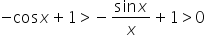
We write more neatly:
[pmath]0< 1-{sinx} /x< 1-cosx[/pmath]
Let’s deal with [pmath]1-cosx[/pmath] :
At the beginning, unfortunately, we must repeat a certain trigonometric formula, namely the formula for the cosine of a double angle:
[pmath]cos2x=cos^2{x} -sin^2{x}[/pmath]
So (from this formula):
[pmath]cosx=cos^2(1/2{x} )-sin^2(1/2{x} )[/pmath]
That is:
[pmath]1-cosx=1-(cos^2(1/2{x} )-sin^2(1/2{x} ))[/pmath]
By splitting the trigonometric number one and putting the minus in the brackets, I get:
[pmath]1-cosx=cos^2(1/2{x} )+sin^2(1/2{x} )-cos^2(1/2{x} )+sin^2(1/2{x} )[/pmath]
That is:
[pmath]1-cosx=2sin^2(1/2{x} )[/pmath]
So back to our inequality:
[pmath]0< 1-{sinx} /x< 1-cosx[/pmath]
We can write it as:
[pmath]0< 1-{sinx} /x< 2sin^2(1/2{x} )[/pmath]
Now let’s deal with [pmath]2sin^2(1/2[/pmath]{x} [pmath])[/pmath] .
It is true that:
[pmath]2sin^2(1/2{x} )< 2sin(1/2{x} )[/pmath]
because for x it is assumed to be in the range [pmath]0[/pmath]< [pmath]x[/pmath]<{pi} [pmath]/2[/pmath] sine values are fractions in the interval (0,1), and such squared fractions are smaller than before squared (for example [pmath], 1/16[/pmath]< [pmath]1/4[/pmath]).
It is also true that:
[pmath]2sin(1/2{x} )< x[/pmath]
because after dividing the inequality by 2 we get:
[pmath]sin(1/2{x} )< x/2[/pmath]
and we showed in the lemma ( [pmath]sinx[/pmath] . that the sine of something is smaller than that something).< [pmath]x[/pmath]< [pmath]tgx[/pmath] ) at the beginning.
So back to our main inequality:
[pmath]0<1-{sinx}/x<2sin^2(1/2{x})<2sin(1/2{x})<x[/pmath]
In short:
[pmath]0< 1-{sinx} /x< x[/pmath]
The above inequality results in the following:
[pmath]delim{|}{1-{sinx} /x}{|}< delim{|}{x} {|}[/pmath]
– the absolute value is the distance from zero, so it will not change when x changes to negative, as long as x remains between 0 and [pmath]pi/2[/pmath] .
Due to the fact that in absolute values [pmath]delim{|}[/pmath]{a-b} [pmath]{|}=delim{|}[/pmath]{b-a} [pmath]{|}[/pmath] :
[pmath]delim{|}{{sinx} /x-1}{|}< delim{|}{x} {|}[/pmath]
Let us repeat, we have shown that the inequality holds (for [pmath]0[/pmath]< [pmath]x[/pmath]<{pi} [pmath]/2[/pmath] ).
[pmath]delim{|}{{sinx} /x-1}{|}< delim{|}{x} {|}[/pmath]
Definition of the limit of the Cauchy function
Recall: if we want to prove from the definition of the limit of the Cauchy function that [pmath]{lim}under{x{right} 0}{sinx} /x=1[/pmath] we have to show that we will always find one [pmath]delta[/pmath]that for anyone [pmath]epsilon[/pmath] will occur:
[pmath]0<delim{|}{x-0}{|}<delta{doubleright}delim{|}{{sinx}/x-1}{|}<epsilon[/pmath]
That is:
[pmath]0<delim{|}{x}{|}<delta{doubleright}delim{|}{{sinx}/x-1}{|}<epsilon[/pmath]
So the matter is simple: if we choose just any [pmath]epsilon[/pmath] – we can always choose [pmath]a delta[/pmath] for it as a number greater than zero, less than epsilon and in the range [pmath]0[/pmath]< [pmath]delta[/pmath]<{pi} [pmath]/2[/pmath].
From inequality [pmath]0< delim{|}{x} {|}< delta[/pmath] our x’s will be smaller than the delta, and since we showed earlier that [pmath]delim{|}{{sinx} /x-1}{|}< delim{|}{x} {|}[/pmath] it is true that:
[pmath]delim{|}{{sinx} /x-1}{|}< delim{|}{x} {|}< delta< epsilon[/pmath]
So we have shown for such [pmath]delta[/pmath] :
[pmath]delim{|}{{sinx} /x-1}{|}< epsilon[/pmath]
So we have shown from Cauchy’s definition that:
[pmath]{lim}under{x{right} 0}{sinx} /x=1[/pmath]
While writing this post, I used…
1. „Differential and integral calculus. Volume I.” GM Fichtenholz. Ed. 1966.
END
Click to remind yourself how to apply limits of functions by definition (previous Lecture)< —