
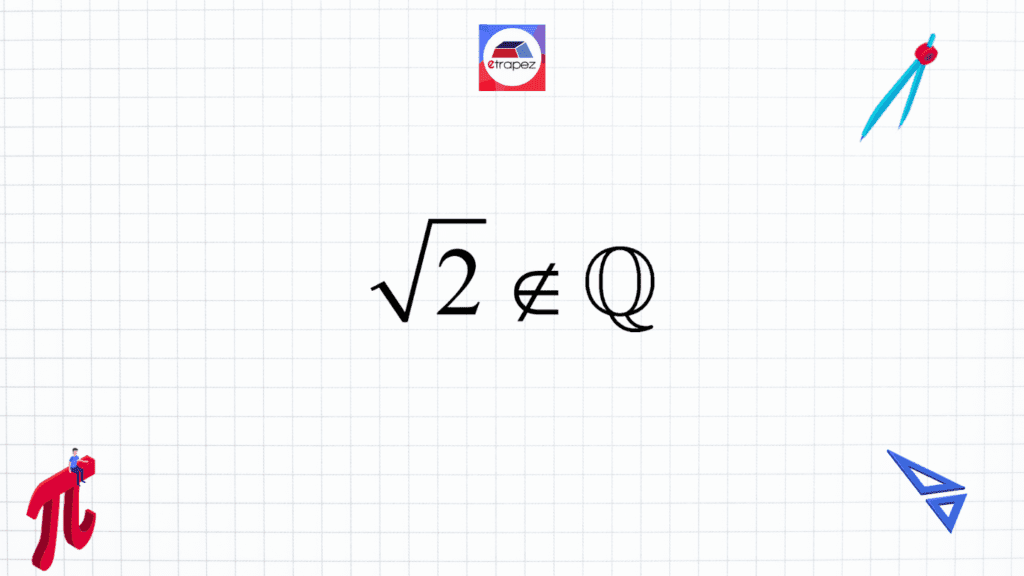

Can every number be written as a fraction?
For a long time, mathematics relied only on natural numbers, integers, and rational numbers. Fractions were enough to measure areas, lengths, and divide goods. Everything seemed elegant and complete.
Until someone looked at the diagonal of a square with side length 1.
Its length is √2.
And this number caused one of the first serious shocks in the history of mathematics.
We will now present the classical proof that:
√2 is not a rational number.
What Is a Rational Number?
A rational number is a number that can be written in the form:
where:
- and are integers,
- ,
- the fraction is in lowest terms, meaning .
This last assumption is crucial. If we assume a number is rational, we can always write it in its simplest form.
Strategy: Proof by Contradiction
We will not try to prove directly that √2 is not a fraction.
Instead, we do something smarter.
We assume the opposite — that √2 is rational — and see where that leads.
Assumptions
Assume there exist integers and such that:
and that the fraction is in lowest terms:
Step 1 – Manipulating the Equation
Square both sides:
Multiply by :
What does this mean?
The left side equals twice an integer. Therefore:
is even.
If the square of a number is even, the number itself must be even.
So:
is even.
Step 2 – Consequences of Evenness
Since is even, we can write:
for some .
Substitute back into the equation:
Divide by 2:
This means:
is even.
Therefore:
is even.
Step 3 – The Contradiction
We have shown that:
- is even,
- is even.
But if both numbers are even, they share the common divisor 2.
That means the fraction is reducible.
However, we initially assumed it was in lowest terms.
This is a contradiction.
Conclusion
The assumption that √2 is rational leads to a contradiction.
Therefore:2 is not a rational number
Why Is This Proof Important?
Because it shows something fundamental:
Not all numbers can be written as fractions.
This was a turning point in mathematics. It forced mathematicians to expand the number system and accept the existence of irrational numbers.