
Limits of Functions – Lecture 6
Topic: Limits of Functions – Cauchy’s Definition
Summary
In this article, I will present the second definition of the limit of a function — the so-called Cauchy definition. Unlike Heine’s definition, which is based on limits of sequences, Cauchy’s definition relies on the concept of a “neighborhood of a point.” Before reading, you should know what a function is (assigning values to arguments), what arguments and function values are, and how to sketch a function on a graph.
“Neighborhood of the point  ” – what is it?
The idea of a neighborhood of the point  is quite simple. Let us assume (there are various definitions) that it is any open interval centered at the point . A number may therefore have many “neighborhoods.” For example, a neighborhood of the number 4 could be the interval (3,5):

…or the interval (3.5,4.5):

…or the interval (2,6):

So we understand what a neighborhood of a point is, right?
Let us also recall from high school how to describe intervals (and thus neighborhoods) using absolute value.
The interval (3,5) consists of points whose distance from 4 is less than 1. Since the distance between two points can be expressed as the absolute value of their difference, points x belonging to the neighborhood (3,5) satisfy:  .
.
The interval (3.5,4.5) consists of points whose distance from 4 is less than 0.5, which can be written as: 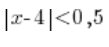 .
.
And which inequality describes the neighborhood (2,6)? It is:  — because the distance from 4 must be less than 2.
Limits of Functions According to Cauchy – Introduction
Cauchy’s definition of the limit of a function is based precisely on neighborhoods — neighborhoods of function values and neighborhoods of arguments. Before attacking the formal definition, let us clarify what neighborhoods of arguments and the corresponding neighborhoods of values are.
Take the function:
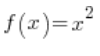
together with its graph:
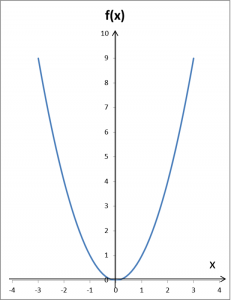
Let us mark a neighborhood of arguments (x-values), for example (1,3):
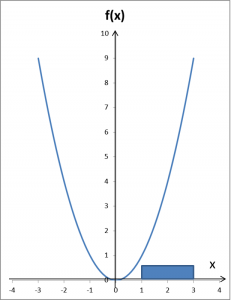
What neighborhood of function values corresponds to this neighborhood of arguments? Looking at the graph:
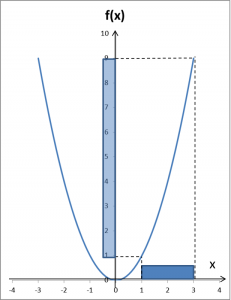
So the neighborhood of arguments (1,3) corresponds to the neighborhood of values (1,9).
Definition of the Limit of a Function
Now that we understand what it means for a neighborhood of arguments to correspond to a neighborhood of values, we can state the official Cauchy definition of a limit.
We call a number g the limit of a function at the point , if:
For every neighborhood (even a very small one) of the value g, there exists a neighborhood of the argument such that the corresponding neighborhood of values is contained in the initially chosen (even very small) neighborhood of g.
Complicated? At first glance — certainly.
Take the function . Suppose it has the limit g = 4 at the point  (which it indeed does). What does that mean?
It means that for any arbitrarily small neighborhood of 4 — for example (3,5):
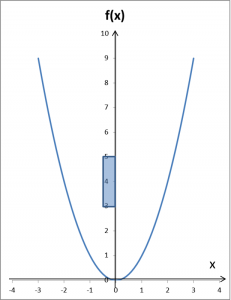
—we can find a neighborhood of the argument 2 such that the corresponding neighborhood of values is contained in (3,5).
It cannot be, for example, the neighborhood (1.5,2.5):
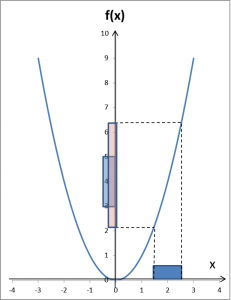
because the corresponding values (2.25,6.25) are NOT contained in (3,5).
We must choose a smaller neighborhood of 2, for example (1.9,2.1):
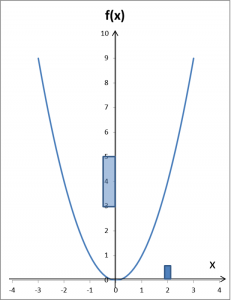
The corresponding neighborhood of values is (3.61,4.41):
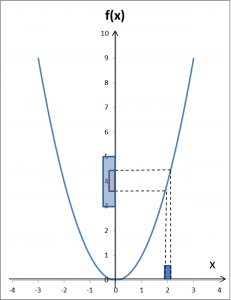
This time it works — the corresponding neighborhood of values is contained in (3,5).
The idea should now be clear. No matter how small a neighborhood of 4 we choose:
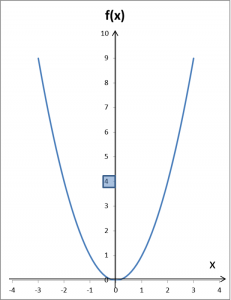
we can always find a neighborhood of 2 whose values are contained in it:
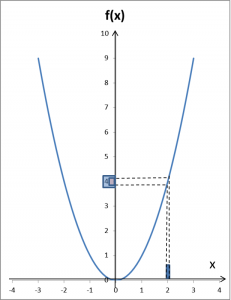
Then we say that the function at the point 2 has limit equal to 4.
Formal Notation of the Definition
Let us now write the definition formally using symbols. As we remember, the neighborhood (3,5) could be written using absolute value as: 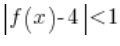 . And
. And  denotes the value of the function.
The symbolic form of the definition looks like this:

THE END
Click to review Heine’s definition of the limit of a function (previous Lecture) <–
Click to see how to use the definition of limits in practice (next Lecture) –>