


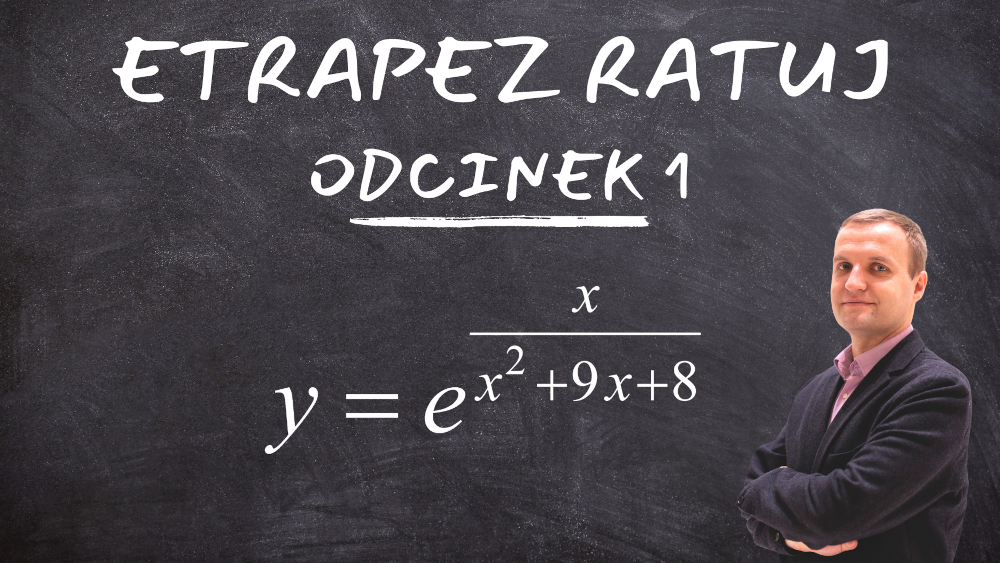

Domain of a Function with e – Why “All Real Numbers” Is Often Wrong
You see in a problem and immediately think:
“Exponential functions are always positive, so the domain must be all real numbers.”
Sounds reasonable.
And that’s exactly why it’s dangerous.
Your Brain Loves Shortcuts
In mathematics, we store patterns. One of them is:
for every real .
That’s true.
But jumping from that fact to the conclusion that the entire function has domain is a mistake.
Because a function is more than just one piece of it.
Where’s the Trap?
The problem usually appears when the exponential expression is part of something bigger — especially a denominator.
And one rule never changes:
You cannot divide by zero.
Even though , the whole denominator containing it may still become zero for some value of .
For example, if the denominator has a form like
,
then plugging in gives:
And now you’re dividing by zero.
So the domain is not all real numbers.
The Real Lesson
Don’t analyze just one fragment of the function.
Always go through a checklist:
- Is there division?
- Could the denominator equal zero?
- Is there an even root?
- Is there a logarithm?
Only after checking everything can you safely determine the domain.
Mathematics rewards precision — not assumptions.